Sri Lanka’s Economy Reaches Pre-Crisis Levels, but Recovery Remains Uneven: World Bank
Sri Lanka’s economy is projected to grow by 4.4% in 2026, with growth reaching 4.7% in the first half of the year and returning to pre-crisis 2018 levels, according to the World Bank. However, poverty remains at 16.9%, while lower wages and high living costs continue to affect vulnerable households. The World Bank says Sri Lanka must move beyond economic recovery towards transformation driven by private investment, exports, productivity and the agribusiness sector.
 editor
GDP growth projected at 4.4% in 2026; private investment, exports and agrifood sector identified as key drivers of next phase of growth
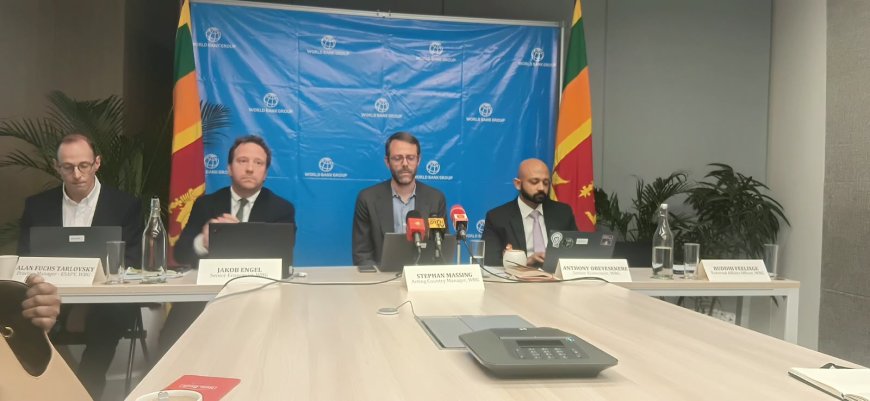
COLOMBO, October 6: Sri Lanka’s economy has reached pre-crisis levels, but the recovery remains incomplete and uneven, with household incomes and labour market outcomes continuing to lag behind the broader economic rebound, according to the World Bank.
The latest Sri Lanka Development Update, “From Recovery to Transformation,” released today, projects Sri Lanka’s GDP to grow by 4.4% in 2026, exceeding earlier projections. Strong industrial performance and steady growth in services are expected to drive the expansion.
However, growth is projected to slow to 4.2% in 2027 as the post-crisis rebound fades and productivity remains weak. The World Bank warned that prolonged volatility in global energy markets and potential impacts from El Niño could pose risks to productivity and food security.
Sri Lanka’s economy has expanded for 12 consecutive quarters, with real GDP increasing by 4.7% in the first half of 2026, returning to 2018 levels.
Fiscal performance has also remained strong, with the primary budget surplus rising significantly. However, inflation has increased in recent months due to higher energy and food prices, while poverty remains well above pre-crisis levels at 16.9%.
“Reaching this milestone marks a beginning, not the end,” said Gevorg Sargsyan, World Bank Group Country Manager for Sri Lanka. He said Sri Lanka needs to build on its recovery momentum to transform the economy and create jobs.
The World Bank said the next phase of growth will require a shift away from government spending towards greater private investment, exports and productivity growth, supported by improved infrastructure, a stable investment environment and greater private sector participation.
Agrifood sector offers major growth potential
The report identifies agribusiness and the wider agrifood system as an important driver of future growth, job creation and poverty reduction.
While primary agriculture accounts for around 8% of GDP, the broader agrifood system — including food processing, logistics, trade and food services — contributes an estimated one-sixth of GDP and more than 40% of employment.
Agribusiness also accounts for nearly 30% of goods exports, making it an important source of foreign exchange and rural livelihoods.
Sri Lanka remains competitive in international markets in products including tea, coconut, cinnamon, seafood and rubber.
According to the report, targeted reforms in trade policy, public spending, infrastructure and access to finance could unlock a new wave of private investment across agricultural value chains, particularly benefiting smallholder farmers and rural communities.
The World Bank recommends creating a more predictable and export-oriented policy environment and redirecting public spending from inefficient subsidies towards productivity-enhancing investments in agricultural research and climate-smart technologies.
Improvements to quality infrastructure, digital traceability and cold-chain logistics, along with reforms to land tenure and access to finance, could further support long-term private investment in agriculture and agribusiness.
The Sri Lanka Development Update forms part of the World Bank Group’s twice-yearly economic assessments. The latest South Asia Economic Update, titled “Adopting AI for Growth,” projects South Asia’s growth at 6.9% in 2026, supported by strong domestic demand.
The report also examines how artificial intelligence can create new sources of growth across South Asia by increasing labour productivity, expanding export opportunities and improving public service delivery.