UN Successfully Concludes Emergency Humanitarian Response to Cyclone Ditwah in Sri Lanka
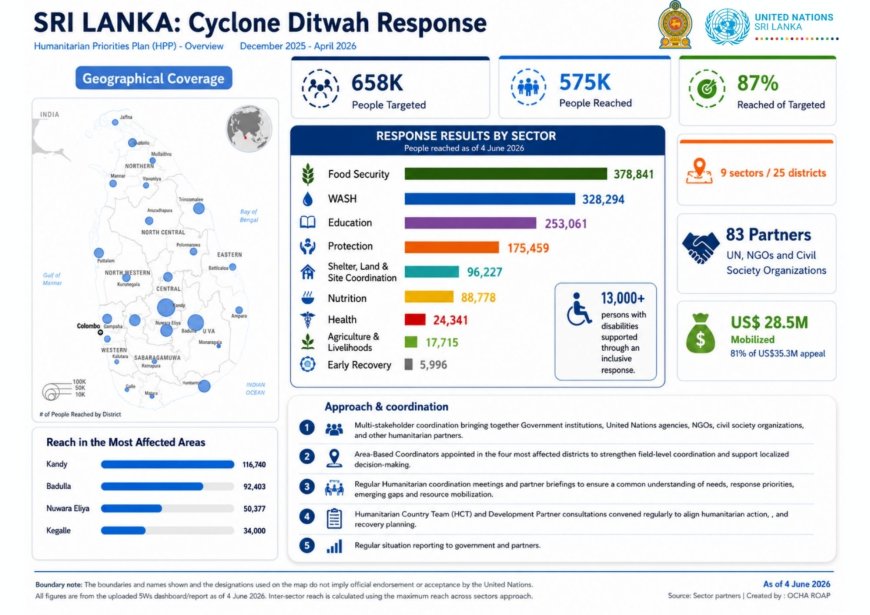
The United Nations and its partners have successfully completed the emergency humanitarian response to Cyclone Ditwah in Sri Lanka, assisting over 575,000 affected people. The focus has now shifted from emergency relief to recovery and reconstruction efforts across the country.
 editor
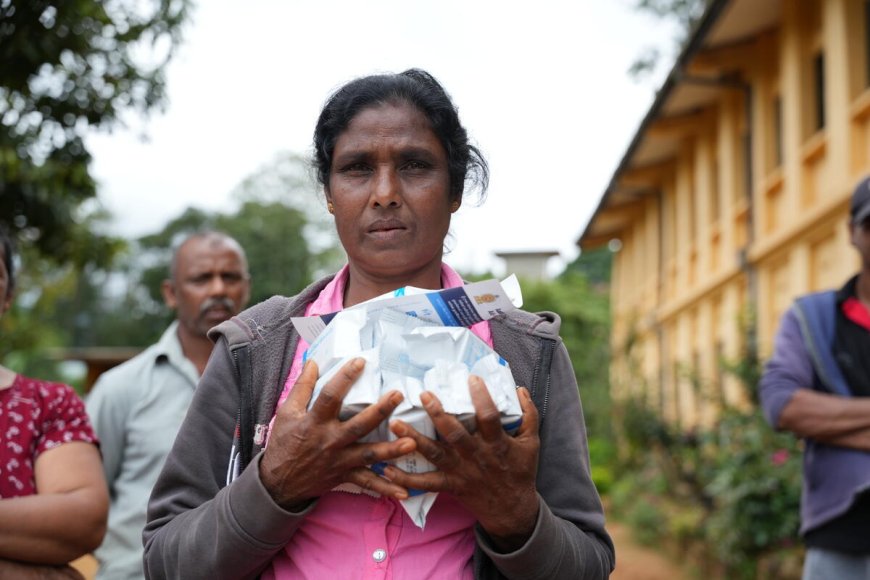
COLOMBO, 11 JUNE 2026: In December 2025, Cyclone Ditwah struck Sri Lanka, triggering the worst flooding and landslides in recent memory. At its peak, over 2.2 million people across all 25 districts were affected, including an estimated 522,000 children. Over 640 people lost their lives and 173 remained missing as of January 2026.
In response to the Government of Sri Lanka’s request, the United Nations and its humanitarian partners launched the Humanitarian Priorities Plan (HPP) on 11 December
2025 — a coordinated effort to direct international assistance to the most urgent needs identified through joint assessments with the Government.
The United Nations and humanitarian partners have now concluded the HPP. To date, critical assistance has been delivered to 575,000 of the most vulnerable people across all 25 districts — with assistance concentrated in the hardest-hit areas of Badulla, Nuwara Eliya, Kandy and Kegalle.
Against a total requirement of US$ 35.3 million, the response raised US$ 28.5 million in donor contributions — a testament to the international community's confidence in the country and its solidarity with the people of Sri Lanka. The response was made possible thanks to Australia, the United Nations Central Emergency Response Fund, the United States, Japan, the European Union, Norway, Canada, the Gates Foundation, the United Kingdom, New Zealand, the Republic of Korea, Cyprus, and Switzerland.
Additional contributions came through UNICEF National Committees in the United States and Germany, the UNICEF Global Thematic Emergency Response Fund, the National Union of Public and General Employees Canada, FAO's Special Fund for Emergency and Resilience Activities, and emergency financing mechanisms of WHO, UNESCO and UNDP.
The international humanitarian response extended well beyond the HPP. Over 20 countries contributed financial bilateral assistance, while 19 countries deployed search and rescue teams or provided in-kind and technical support — a reflection of the breadth of international solidarity with Sri Lanka.
Behind the numbers are countless personal experiences. Alice Nona was at home with her three children in Kandy District, when Cyclone Ditwah struck. By the time the storm
passed, their house had completely collapsed. “We lost everything and were displaced overnight,” she says. Alice, a single mother, received emergency cash assistance through the HPP. “We used the money for food and other essentials, and to buy clothes for my children. We are thankful for the support, as we had nothing at the time.”
Throughout, the HPP was designed to complement national efforts by delivering quickly and focusing on reaching the most vulnerable first. The HPP provided cash assistance to families in need — complementing the Government's own cash assistance programme — as well as transitional shelters to displaced households, while ensuring that the shelters had access to safe water and sanitation. 83 partner organizations worked alongside the Ministry of Foreign Affairs, the Disaster Management Centre, the National Disaster Relief Services Centre, relevant ministries, and the Commissioner-General of Essential Services — ensuring that international support reinforced the Government's own response.
“When national leadership is strong, when local ownership is respected, and when partnerships are effective, we can deliver help more quickly, more fairly, and more efficiently to those who need it most, said Prabath Chandrakeerthi, Commissioner General of Essential Services. The partnership demonstrated through the Humanitarian Priorities Plan has shown that Sri Lanka can respond more effectively when we act together, with clarity of purpose and respect for each other's roles.
“Sri Lanka did not face this terrible disaster alone," said Marc-André Franche, United Nations Resident Coordinator in Sri Lanka. "From the very first days, humanitarian partners and the government worked shoulder to shoulder — from the national level to the most affected villages. The international community rallied, and the resilience and solidarity shown by the Sri Lankan people themselves was nothing short of inspiring. The road to recovery is long — and we will walk every step of it alongside the Government and people of Sri Lanka.
Even as the humanitarian response concludes, the scale of the recovery challenge is becoming clearer. The Government's Post-Disaster Needs Assessment estimates resilient recovery and reconstruction needs at US$ 3.4 billion. An estimated 113,000 homes were damaged or destroyed — with the heaviest toll falling on those already most vulnerable: women, children, plantation communities, and informal workers, many of whom were still recovering from the 2022 economic crisis.
While the HPP is concluding, the recovery journey is far from over. Many families remain displaced, facing complex challenges around land and permanent housing. The Government has taken important steps, including the rollout of transitional shelter programmes and ongoing efforts to support relocation and permanent housing for affected households. The UN and partners remain closely engaged with the Government to help bridge remaining gaps and ensure that no family is left behind.
Cyclone Ditwah is a stark reminder of the urgent need to invest in disaster preparedness and community resilience as climate change drives more frequent and intense weather events across the region — so that when the next storm comes, communities are far better placed to weather it. As the focus shifts from emergency response to recovery, reconstruction and the rebuilding of lives and livelihoods, the UN remains committed to standing alongside the Government and people of Sri Lanka every step of the way.