World’s Largest Electorate: How India Strengthens Democracy Through Transparency and Inclusion
With nearly one billion eligible voters, India’s electoral system combines technology, transparency and inclusive initiatives to strengthen democratic participation and public trust.
 editor
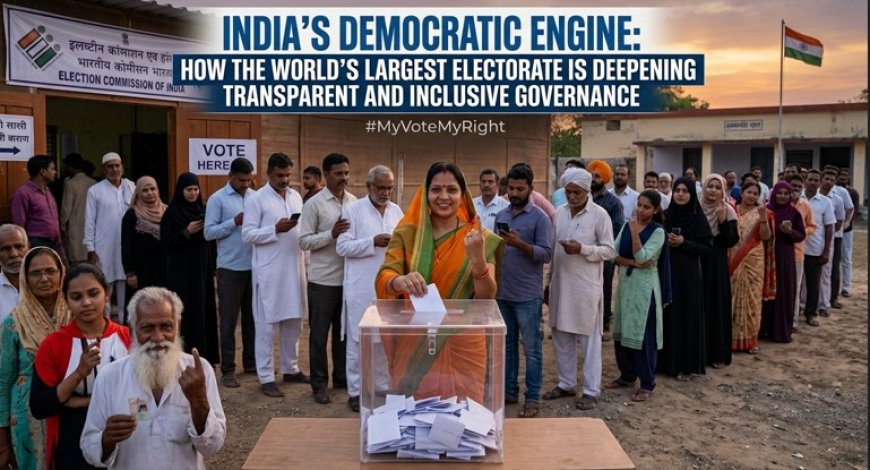
India’s Democratic Engine: How the World’s Largest Electorate Strengthens Transparent and Inclusive Governance
In a country where around one billion citizens are eligible to vote, democracy extends beyond a constitutional principle to become a powerful demonstration of large-scale coordination, public participation and trust. In India, the sheer scale of this democratic exercise is supported by a technologically advanced electoral system, a constitutionally mandated Election Commission and sustained efforts to make voting accessible to people from all sections of society.
Democracy on a Massive Scale
India’s electoral system currently serves an electorate of around 1 billion voters. During the 2024 Lok Sabha elections, 646.4 million votes were cast, with voter turnout reaching 66.10 percent, demonstrating one of the largest exercises of democratic participation in the world.
Women’s participation has also recorded significant progress. Women accounted for 48.62 percent of registered voters in 2024. Their voter turnout stood at 65.78 percent, marginally higher than the 65.55 percent turnout recorded among men.
Institutional Transparency in the Electoral Process
The Election Commission of India seeks to maintain transparency throughout the electoral process, from voter registration and polling to vote counting and post-election procedures.
The Voter Verifiable Paper Audit Trail (VVPAT), integrated with Electronic Voting Machines (EVMs), enables voters to verify the candidate they voted for through a printed paper slip displayed for seven seconds.
Digital platforms such as cVIGIL also enable citizens to report violations of election regulations promptly. Voters can use the official Election Commission website and voter service portal to register, verify and access electoral information.
Technology Centred on Voters
Under new measures, voters are to receive their Electoral Photo Identity Cards (EPIC) within 15 days of changes being made to their details, along with SMS notifications.
Polling arrangements have also been streamlined to reduce congestion, with polling stations structured to accommodate a maximum of 1,200 voters.
Building an Inclusive Democracy
The electoral administration places particular emphasis on ensuring the participation of senior citizens, persons with disabilities, women, young people and tribal communities living in remote areas.
Facilities have been introduced to enable voters aged above 85 and persons with disabilities to cast their ballots from home. Awareness initiatives have also been strengthened through the Systematic Voters’ Education and Electoral Participation (SVEEP) programme.
Sharing Democratic Experience Globally
India’s electoral administration has also gained international recognition. The India International Institute of Democracy and Election Management (IIIDEM) has trained election officials from more than 100 countries over the past 15 years.
From universal adult suffrage after independence to Electronic Voting Machines, VVPAT and digital voter services, India’s electoral system continues to reinforce its fundamental principle: “Power rests with the voter.”