Understanding the Ethnic Unity and Progress Promotion Law of China from a big-picture historical perspective
China’s Ethnic Unity and Progress Promotion Law seeks to strengthen national unity, promote ethnic development and support China’s modernization from a broader historical perspective.
 editor
The law not only addresses the question of "achieving success oneself" but also provides a framework for "helping others succeed."
Author: Wang Yiwei
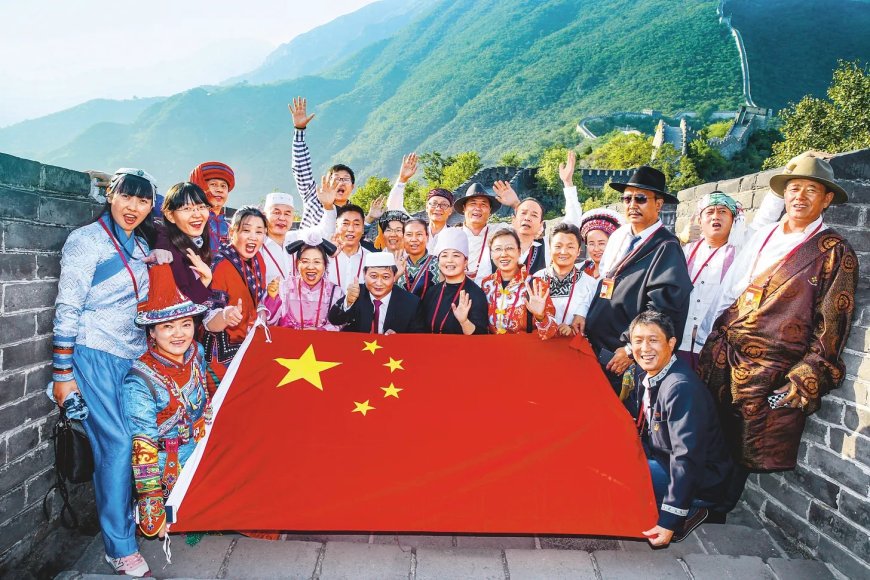
People from various ethnic groups took a group photo at the Great Wall. (Photo by Niangjijia)
Shifts in modes of thinking, international rules, and the international system since the advent of modernity have, produced a Western logic of division and linear evolution. The enactment of the Ethnic Unity and Progress Promotion Law is presented as an important measure for China to respond to these historic changes and strengthen the cohesion of the Chinese nation through national legislation.
The prerequisite for China to advance Chinese modernization and achieve the great rejuvenation of the Chinese nation is to realize the great unity of the Chinese nation.
In March 2026, the Fourth Session of the 14th National People’s Congress deliberated and adopted the Ethnic Unity and Progress Promotion Law of the People’s Republic of China. Only by understanding this law from a big-picture historical perspective can we grasp the epochal value of promoting national unity and progress and the jurisprudential foundation for the great rejuvenation of the Chinese nation.
The foundations of history
From a broad historical perspective, Chinese civilization is the world’s only major civilization that has continued uninterrupted to the present day in the form of a state. To understand China, one must look beyond Western conceptions of history, nationhood, and the state.
“Great unity” (Dayitong) is a defining characteristic that distinguishes China from the West. In Europe, no empire comparable to Rome emerged after its collapse, whereas China’s tradition of “great unity” has endured to the present day. An important figure in the creative modern theoretical development of this concept was Liang Qichao (1873–1929). In 1902, he introduced the concept of “the Chinese nation,” moving beyond narrow nationalism and the Western notion of nations as “imagined communities.”
However, old China was devastated by imperialist aggression, particularly from Japan. The nation endured humiliation, the people suffered, and the civilization was diminished. The national anthem of the People’s Republic of China, “March of the Volunteers,” gave voice to the warning that “the Chinese people have arrived at their most perilous time.” Only with the founding of the People’s Republic of China, when the new China replaced the old, was the political foundation for Chinese modernization established.
The founding of the People’s Republic of China brought an end to the era of “disunity and poverty” that had characterized modern China (1840–1949) and opened a path toward socialist modernization based on the country’s own conditions. The Law of the People’s Republic of China on Regional Ethnic Autonomy, adopted in 1984, played an important role in promoting ethnic unity within the socialist state.
In 2021, Chinese president Xi Jinping put forward the “Second Integration” (the formal introduction of the “Two Integrations” for the first time, with the “Second Integration” referring to the integration of basic principles of Marxism with fine traditional Chinese culture). It implies that modernization is not extermination of tradition but creative transformation and innovative development of traditional culture. China has opened up new prospects for Chinese modernization, achieving the trinity of country (territory-geography), nation (ethnicity-psychology), and state (governance-administration), unified under the subject (people). This is encapsulated in the argument that “This country is its people; the people are the country.” This is the political connotation of the “people’s republic” and the underlying meaning of the word “Chinese” in Chinese modernization. In 2018, the constitutional amendment incorporated the “Chinese nation” into the Constitution for the first time, clearly stipulating to “safeguard and develop relationships of equality, unity, mutual assistance, and harmony among all ethnic groups.”
In accordance with the spirit of the Constitution, China enacted the Ethnic Unity and Progress Promotion Law, transforming the belief in great unity—that the country cannot be divided, the state cannot be thrown into chaos, the nation cannot be fragmented, and the civilization cannot be interrupted—into law. The law articulates the historical trajectory of modern China’s heroic struggle to survive and resist foreign aggression, during which the Chinese nation achieved its great transformation from an ethnic group in itself to one for itself. It promotes the building of a community with a shared future characterized by integration of bloodlines, shared beliefs, cultural interconnection, economic interdependence, and emotional kinship.
Inspiration across dimensions
From the perspective of decades, contemporary China is undergoing profound transformation. The Ethnic Unity and Progress Promotion Law moves beyond a contractual logic by upholding the principle of “harmonious coexistence.” It transcends the Western concept of national self-determination with the great national unity, safeguarding security through unity, affirming that “ethnic unity is the lifeline of the people of all ethnic groups in China,” and boosting progress by “promoting Chinese modernization through the great unity of the Chinese nation.” In this way, the law contributes Chinese wisdom and Chinese solutions to practices of ethnic identity and national governance around the world.
From the perspective of centuries, countries and regions across the globe are confronting profound changes unseen in a hundred years. Shifts in modes of thinking, international rules, and the international system since the advent of modernity have, produced a Western logic of division and linear evolution. The enactment of the Ethnic Unity and Progress Promotion Law is presented as an important measure for China to respond to these historic changes and strengthen the cohesion of the Chinese nation through national legislation. The law clearly states that safeguarding national unity and promoting ethnic unity and progress are shared responsibilities of all Chinese citizens, and it calls for the prevention and resolution of major risks and potential challenges in ethnic affairs through legal means.
From the perspective of millennia, what may be the true course of world history is now unfolding. The Ethnic Unity and Progress Promotion Law lays a jurisprudential foundation for the great rejuvenation of the Chinese nation.
In The German Ideology, Marx observed that “as the scope of mutually influential activities expands in the course of this development, and as the primitive closed state of various nations is increasingly thoroughly broken down by more advanced production methods, communication, and the natural division of labor among different nations that arises from the communication, history becomes the world’s history at a deeper level.”
The classical economist David Hume once predicted that “when the arts and sciences reach perfection in a country, they will inevitably decline, or at least will not be revived in the same country.” The great rejuvenation of the Chinese nation is overcoming the “Hume paradox” and embracing the advent of “true world history.”
The national flag of the People’s Republic of China is a five-star red flag, with four smaller stars surrounding one larger star. By contrast, the French tricolor consists of blue, white, and red vertical bands, a design that influenced the flags of several European countries, including Russia. In this interpretation, the symbolism of the two flags reflects the contrast between China’s culture of great unity and what is characterized as a Western tradition of binary opposition. The Communist Party of China has preserved the country’s millennia-old tradition of great unity, united and organized the Chinese people, and reversed the historical pattern of weakness and vulnerability to foreign aggression that marked much of the modern era.
Today, ethnic unity and progress are essential to building a strong country and achieving the great rejuvenation of the Chinese nation. Whether in overcoming the constraints associated with the Hu Line (Heihe-Tengchong Line) to pursue common prosperity or in implementing the 15th Five-Year Plan for high-quality development, success is seen as dependent on the solid foundation of the great unity of the Chinese nation.
The promulgation of the Ethnic Unity and Progress Promotion Law guides China’s nation-building efforts and shapes ethnic identity, encouraging a shift from individual and ethnic perspectives toward a thought of unity and community. It upholds the principle that the shared unity, collective endeavor, common development, and mutual prosperity of all ethnic groups constitute the lifeblood, source of strength, and hope of the Chinese nation, while further enhancing China’s international competitiveness as a civilization-state.
The global significance of “succeeding oneself while helping others succeed”
The Ethnic Unity and Progress Promotion Law not only addresses the question of “achieving success oneself” but also provides a framework for “helping others succeed.”
Article 19 of the law stipulates that “the state promotes the development of international communication capabilities, supports foreign people-to-people and cultural exchanges, explains the history of the Chinese nation and the theory on the community of the Chinese nation, disseminates the practice and achievements of building the community of the Chinese nation, facilitates the world’s better understanding and perception of the Chinese nation and Chinese culture, and promotes exchanges and mutual learning among human civilizations.” Article 34 stipulates that “the state supports ethnic regions in leveraging their own advantages to serve the construction of a new development paradigm in which the domestic great circulation is the mainstay while domestic and international circulations reinforce one another, and to integrate deeply into the high-quality joint development of the Belt and Road.” Together, these two articles highlight the law’s outward-looking dimension, emphasizing exchanges and mutual learning among civilizations, participation in the Belt and Road Initiative, and domestic and international dual circulations.
The world today is undergoing profound changes unseen in a century. The enactment of the Ethnic Unity and Progress Promotion Law follows the general development trend of the Chinese nation moving from history to the future, from tradition to modernity, and from diversity into unity. It promotes the development of the Chinese nation into a community with a shared future featuring higher identification and stronger cohesion.
The community of the Chinese nation is an important component and practical foundation of the community with a shared future for mankind. “The great unity of the Chinese nation” also provides profound inspiration and guidance for “the great unity of the peoples of the world,” offering impetus for the building of a community with a shared future for mankind and demonstrating a model for the world to move beyond conflicts and toward harmony.